Cats are not just “small dogs” in diagnostic workflows. Feline venipuncture can be stressful, peripheral veins are small, and repeated sampling may be difficult in anxious, dehydrated, geriatric or critically ill patients. For clinics, the practical challenge is not only collecting blood - it is obtaining enough reliable information from the smallest reasonable sample volume.
Modern feline care increasingly depends on fast in-clinic decisions: inflammation assessment, pancreatitis support, thyroid evaluation, adrenal/reproductive hormone review and treatment monitoring. A compact analyzer that supports quantitative results with assay-specific small sample input can help reduce delays while keeping results interpretable and traceable.
|
Core message: Micro-sampling is not about using less blood at any cost. It means matching the assay to the smallest appropriate sample volume while maintaining quantitative performance, quality control and clinical interpretation. |
Traditional rapid formats can be useful for simple screening, but feline cases often require more than a positive/negative answer. Inflammation markers may need follow-up trends, thyroid results require numerical interpretation, and pancreatic or endocrine disorders benefit from objective concentration data. Quantitative CLIA testing brings laboratory-style immunoassay thinking closer to the consultation room.
|
Feline diagnostic need |
Common challenge |
What compact CLIA adds |
|
Low blood volume |
Small veins, stress, difficult repeat draws |
Assay-specific small sample input with a controlled workflow |
|
Fast decision-making |
Send-out delay may slow treatment discussion |
In-clinic result in minutes for selected assays |
|
Disease follow-up |
Visual/qualitative results are hard to trend |
Numeric values support monitoring over time |
|
Clinic operations |
Limited space, variable testing demand |
Bench-top format, independent positions and single-test reagents |
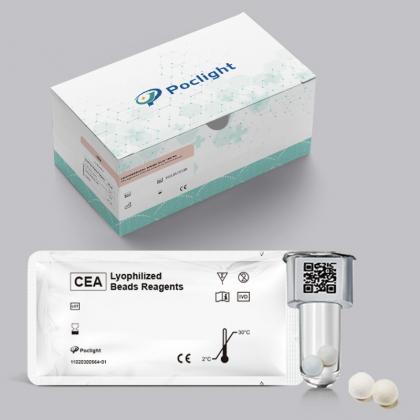
Poclight Veterinary C5000 is positioned as a dry micro chemiluminescence immunoassay analyzer for veterinary scenarios including veterinary hospitals and independent laboratories. Key product language: compact analyzer, easy operation, quantitative CLIA, lyophilized beads, no cold-chain need and results in minutes for selected assays.
|
Product point |
Suggested blog wording |
|
Analyzer principle |
Homogeneous chemiluminescence immunoassay (CLIA) |
|
Clinic fit |
Compact, lightweight bench-top format; 325 x 231 x 213 mm; <=8.5 kg |
|
Workflow |
Add sample / load reagent / read result; seven independent test positions |
|
Reagents |
Lyophilized beads, individual packaging, 2-30°C storage, no cold-chain logistics |
|
Result type |
Quantitative results to support clinical interpretation and follow-up trends |
|
Category |
Assays to show |
Sample / timing emphasis |
|
Inflammation |
SAA |
fSAA: serum/plasma; 10 µL sample to diluent; 5 min; measuring range 5-300 mg/L |
|
Pancreas |
PL |
For pancreatic assessment support; follow final IFU for sample volume and interpretation |
|
Thyroid |
TT4, FT4, TT3, FT3 |
Serum/plasma; small-volume hormone panel positioning; TT3 and FT3 listed as 50 µL / 5 min in IFU |
|
Hormone |
Cor, Prog |
For endocrine and reproductive assessment support; follow final IFU |
|
Metabolism |
AD / A-VD* |
*Confirm final English product name before publication |
In feline practice, every microliter matters. A calm blood draw, a reliable tube, and a small assay input can make the difference between completing the test in the clinic and postponing a decision. This is especially important for cats that are stressed, underweight, dehydrated, geriatric or difficult to restrain.
Poclight Veterinary C5000 brings quantitative CLIA testing into a compact in-clinic format. Instead of relying only on broad visual screening, veterinary teams can obtain numerical biomarker results for selected feline assays, supporting inflammation review, endocrine assessment, pancreatic evaluation and follow-up monitoring. For example, Poclight fSAA uses a 10 µL sample input into diluent and provides a quantitative result in 5 minutes, supporting rapid assessment of feline systemic inflammation.
For veterinary clinics, the value is practical: less waiting, assay-specific small-volume workflows, individual lyophilized reagents, simplified operation and a compact instrument footprint. For cats, it supports a more patient-friendly diagnostic experience. For veterinarians, it helps turn small samples into actionable information - interpreted together with physical examination, history, imaging and other laboratory findings.



 IPv6ネットワークがサポートされています | XML | サイトマップ | ブログ | プライバシーポリシー
伝言を残す
スキャンしてWeChatに送信 :


 English
 français
 русский
 español
 português
 العربية
 日本語
日本語 Türkçe
 हिंदी
हिंदी Indonesia